1. Why This Decision Can Make or Break Your Unboxing Experience
Let me be completely candid. If you ask a typical packaging sales rep, they will usually push whatever board caliper their factory has surplus reels of in their inventory. But out in the field—when your customer receives your box in London, Frankfurt, or New York after a 30-day ocean voyage and six rough handling transfers through DHL or UPS chutes—the micro-geometry of that corrugated flute is the only barrier keeping your product intact.
Over the past 16 years running corrugating lines here in Fujian, I have watched DTC brands spend \$30,000 on high-end graphic design, only for their boxes to arrive looking like a washboard with wavy ridges visible straight through their gorgeous pastel branding. That catastrophic visual flaw is directly rooted in choosing the wrong flute architecture.
2. The Physics of the Arch: E-Flute vs. B-Flute Architecture
Corrugated board isn't solid cardboard. It is an engineered composite beam consisting of an arched fluting paper medium glued between two flat linerboards (the outer and inner liners). The secret to its strength is the arch—the same architectural principle the Romans used for stone aqueducts.
Here is how the structural metrics break down under our caliber gauges:
- E-Flute Profile: Caliper thickness of approximately 1.5mm (1/16 inch). It packs roughly 90 to 96 flutes per linear foot (approx. 290 to 310 flutes per meter). Because the peaks of the arches are spaced so closely together (pitch: 3.2mm), it provides an exceptionally flat, dense support bed for the outer paper liner.
- B-Flute Profile: Caliper thickness of approximately 3.0mm (1/8 inch). It contains roughly 47 to 50 flutes per linear foot (approx. 150 to 165 flutes per meter) with a wider pitch of approximately 6.5mm. The arches are taller, which means more air space between the paper liners, offering greater shock-cushioning and impact deflection.

3. The Washboard Effect and Print Resolution
"Washboarding" is the industry term for the visible ribbing effect where the liner paper sags between the flute tips. It occurs when moisture from water-based adhesive dries, causing the paper liner to shrink slightly into the hollow valleys between each arch.
With B-Flute, the span between peaks is wide (6.5mm). If you use a lightweight outer liner (such as 140gsm or 175gsm kraft) with heavy dark solid ink coverage or large flood coats, washboarding is virtually inevitable under glancing light. You will see zebra-like vertical stripes across your custom logo.
With E-Flute, the arch peaks are only 3.2mm apart. The outer liner has less than half the distance to span between support glue lines. This flat, uniform surface allows high-definition CMYK offset litho-laminating and flexographic printing up to 150 LPI (lines per inch) without visible fluting telegraphing through your artwork. If your branding relies on fine micro-typography, crisp barcode scanning, or soft gradient photography, E-Flute is mathematically superior.
4. Real-World Drop Testing: Cushioning vs. Puncture Resistance
Now let's talk about mechanical protection. Does the thinner 1.5mm E-Flute sacrifice your product's safety?
In our on-site packaging testing lab, we run ISTA-1A drop tests from heights of 36 inches onto solid steel plates. What we have observed over thousands of drop cycles surprises many new buyers:
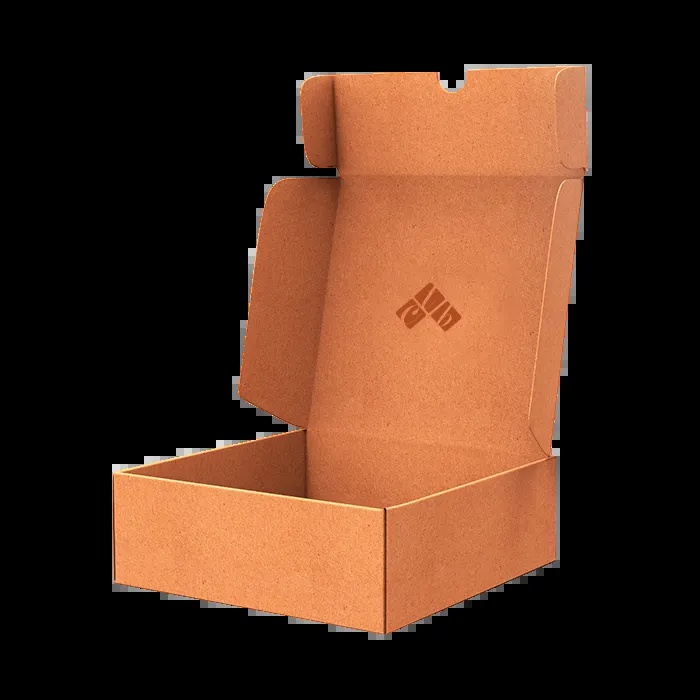
For lightweight to medium-weight products (under 2.5 kg / 5.5 lbs)—such as skincare bottles, apparel, tech accessories, coffee beans, and jewelry—E-Flute performs remarkably well because the rigid roll-end tuck construction (FEFCO 0427) creates double-thickness side walls (3.0mm total) and a triple-thickness front closure lock. Its high flute density resists point punctures from sharp corners.
However, when product weight exceeds 3.5 kg (such as heavy ceramic mugs, candle jars, metal hardware, or multi-packs of glass bottles), the 1.5mm wall of E-flute does not possess enough air volume to absorb high-velocity impact decelerations. In that scenario, B-Flute's 3.0mm air chamber acts as an energy-dissipating crumple zone, cushioning the shock wave before it transmits into the glass or porcelain payload.
5. Engineering Comparison Table
| Engineering Parameter | E-Flute (Micro-Flute) | B-Flute (Standard Mailer) |
|---|---|---|
| Nominal Caliper Thickness | 1.5 mm (0.06 in) | 3.0 mm (0.12 in) |
| Flute Pitch (Peak to Peak) | ~3.2 mm (Dense) | ~6.5 mm (Wide) |
| Flute Count per Meter | 290 - 310 flutes/m | 150 - 165 flutes/m |
| Surface Print Quality | Superior (Near-zero washboarding) | Moderate (Requires ≥200gsm liner) |
| Flat Crush Resistance | High (Resists roller indentation) | Moderate |
| Ideal Payload Weight | Up to 2.5 kg (5.5 lbs) | 2.5 kg to 8.0 kg (5.5 - 17.6 lbs) |
| Pallet Volume Efficiency | 40% to 50% more boxes per pallet | Standard volume baseline |
6. The Hidden Ocean Freight & Warehouse Calculation
Here is a factor that almost every brand manager overlooks until their first invoice from a 3PL freight forwarder arrives: Pallet Stacking Density.
Because corrugated mailers are shipped flat-packed in bundles (or on export pallets), a 1.5mm E-Flute box occupies half the vertical height of a 3.0mm B-Flute box. When we palletize 5,000 flat-pack mailers:
- B-Flute: Requires roughly 5 to 6 standard pallets, taking up significant cubic volume inside a 40HQ container and incurring high monthly 3PL pallet storage fees.
- E-Flute: Fits comfortably onto 3 pallets. That represents a direct 45% to 50% savings on inbound freight and warehouse intake slotting fees before you even ship a single customer order!
7. My 4-Step Rule of Thumb for Your Brand
Whenever I consult with an engineering client at Naike, I walk them through this straightforward decision framework:
- Choose E-Flute if: Your product is under 2.5 kg, retail aesthetic and luxury unboxing are paramount, your artwork has dense colorful printing, and you want to minimize 3PL storage fees and ocean freight. (Perfect for: cosmetics, supplements, apparel, accessories, coffee/tea, consumer electronics).
- Choose B-Flute if: Your product is dense, heavy, or fragile without primary cushioning, and the box acts as the primary external shipping envelope subjected directly to postal sorting equipment. (Perfect for: glassware, ceramics, wine bottles, industrial components, subscription boxes packed over 4 kg).
- Need the Ultimate Balance? Consider F-Flute or EB-Flute: For ultra-miniature cosmetic packaging, we also convert 0.9mm F-Flute. For heavy-duty luxury shipments requiring bulletproof protection with silk-screen printing, we manufacture dual-wall EB-Flute (4.5mm).
8. Detailed Case Study: The California Coffee Brand That Switched from B-Flute to E-Flute
To make this concrete, let me share a real project from our Jinjiang plant records. In early 2024, a specialty organic coffee roaster in Santa Monica, California, reached out to our engineering desk. They were shipping a monthly subscription box containing two 12-ounce bags of whole-bean coffee and a branded ceramic tasting cup (total payload weight: 1.15 kg / 2.53 lbs).
Their existing packaging was a standard B-Flute tuck-top mailer manufactured by a local distributor in the US. They were facing three severe operational headaches:
- The Washboard Flaw: Their box design featured a deep matte navy flood coat with delicate metallic gold line art depicting coffee plant branches. On B-Flute, the corrugated ridges showed through prominently, creating horizontal ripples that made the intricate botanical illustrations look broken and cheap.
- Fulfillment Assembly Slowness: B-Flute's 3.0mm thickness made the front locking tabs stiff and resistant to quick folding. Their warehouse fulfillment team took an average of 14 seconds to erect each box, creating a major bottleneck during holiday peak runs.
- Inbound Pallet Costs: They received 10,000 flat-pack boxes every two months. In B-Flute, this required 12 full pallet spaces in their crowded Los Angeles warehouse, costing them $35 per pallet per month in storage fees alone.
We took their product dimensions and rebuilt the structure from scratch in our CAD system. Here is the exact transformation we executed:
- We transitioned the substrate from 3.0mm B-Flute to 1.5mm high-density E-Flute (94 flutes per foot).
- To guarantee the ceramic tasting cup survived postal transit without relying on plastic bubble wrap, we engineered a custom die-cut E-flute internal suspension insert that locked the cup in place with a 15mm air buffer around all sides.
- We upgraded the outer paper liner to a 250gsm coated white-top kraft board laminated over 120gsm virgin semi-chemical fluting medium.
The Real-World Results:
- Zero Washboarding: The deep navy flood coat was printed on our Heidelberg 7-color press at 175 LPI. The surface was as flat and smooth as luxury rigid cardboard, with flawless gold foil registration.
- Assembly Speed Cut in Half: The crisp, laser-creased score lines on E-flute folded effortlessly. Box erection time dropped from 14 seconds to just 5.8 seconds per box, saving them over 22 hours of fulfillment labor per 10,000 units.
- Warehouse Footprint Slashed by 50%: The entire 10,000-box delivery occupied only 6 pallets instead of 12, instantly cutting their monthly storage bill in half and freeing up critical inventory floor space.
9. Flute Caliper Compression & Score Cracking: The Engineer's Pre-Flight Checklist
When you receive physical sample boxes from an overseas manufacturer, do not just glance at the print color. As a packaging engineer, here is the exact 5-point physical audit I perform on the press floor:
- Check the 180° Fold Hinge: Fold the main lid back 180 degrees five consecutive times. If the outer paper liner splits, tears, or shows white fiber fracture along the crease, the manufacturer used brittle paper with insufficient moisture content (below 6%) or applied excessive crushing pressure during die-cutting.
- Caliper Gauge Verification: Measure the thickness of the flat sheet using a digital micrometer. A genuine E-Flute must measure between 1.45mm and 1.60mm. If it measures 1.20mm, the corrugating rollers crushed the flutes during laminating, destroying up to 30% of its edgewise crush resistance.
- Measure Dust Flap Friction: Close the side dust flaps into the box. They should slide in with gentle tactile resistance. If they are loose, the box will pop open during high-speed conveyor drops. If they are too tight, your fulfillment staff will tear the edges during assembly.
- Internal Flute Direction Alignment: In roll-end tuck mailers (FEFCO 0427), the flute direction must run parallel to the side walls to maximize vertical stacking strength. If the converter nested the die-line perpendicular to save paper board yield, the side walls will buckle under minimal top load.
- Adhesion Fiber Tear Test: Slowly peel the outer liner paper away from the fluting medium. You should see genuine fiber tear (the paper rips itself rather than cleanly releasing the glue line). If the liner peels away cleanly, the starch adhesive was under-cooked or applied too cold.
10. Frequently Asked Questions from Global Buyers
Q: Can I use E-Flute for international postal shipping without an outer poly mailer bag?
A: Absolutely. Over 80% of our DTC e-commerce clients ship their E-flute mailer boxes directly through USPS, Royal Mail, and DHL without an outer poly bag. When engineered with self-locking roll-end flaps and sealed with a tamper-evident paper label or water-activated kraft tape, E-flute easily withstands normal single-parcel handling.
Q: Is B-Flute cheaper than E-Flute because it has fewer flutes?
A: Surprisingly, no. The cost of corrugated board is governed primarily by paper basis weight (total grams of paper pulp) rather than flute frequency. Because B-flute requires heavier linerboards (200gsm+) to prevent washboarding, a high-quality B-flute box is often 5% to 8% more expensive than an equivalent E-flute box.
Q: What is F-Flute, and should I consider it instead of E-Flute?
A: F-Flute is an ultra-micro flute measuring just 0.8mm to 1.0mm in caliper, with approximately 128 flutes per foot. It is primarily used for small luxury cosmetics, perfume bottles, and fast-food retail cartons where paperboard folding crispness is needed alongside light thermal insulation. For standard shipping mailers, E-Flute remains the proven industry benchmark.
11. In-Depth Manufacturing SOP: From Reel Slitting to Finished Flat-Pack
To give you complete transparency into how your boxes are physically produced, here is our standard 7-step corrugating sequence on our 2.5-meter continuous line in Jinjiang:
- Pulp Conditioning (Pre-Heater Drum): Before fluting paper enters the corrugating rolls, it passes over steam-heated drums at 165°C to 180°C. This softens the lignin inside the wood fibers, allowing the paper to form into sharp, uniform arches without micro-fracturing along the flute peaks.
- Single-Facer Fluting & Starch Bonding: The heated medium feeds through intermeshed corrugating rolls under pneumatic pressure. Modified corn-starch adhesive is applied with anilox precision (dry coat weight: 3.5gsm ±0.3gsm). The outer liner is instantly bonded under high temperature, creating single-face web.
- Double-Facer Glue Application: The exposed flute tips pass over a second glue applicator roll. The inner linerboard is brought into contact and pressed flat across 14 meters of continuous steam-heated hot plates.
- Controlled Slow Cooling & Moisture Balancing: Corrugated board must cool gradually under weighted canvas belts. If cooled too rapidly or unevenly, the moisture differential between the top liner and bottom liner causes immediate sheet curl (up-warp or down-warp), which ruins flatbed die-cutting accuracy.
- Laser-Guided CNC Die-Cutting: Flat sheets are fed at speeds up to 6,000 sheets/hour into our automated flatbed die-cutters. Swiss-imported steel rule knives slice through the board with ±0.15mm registration, while rounded creasing matrices compress the fold lines without rupturing surface fibers.
- Automated Stripping & Scrap Ejection: High-speed vibrating pins and air jets strip away all waste borders, window knockouts, and thumb notches, ensuring zero paper dust remains inside the boxes.
- Bundle Strapping & Moisture-Barrier Stretch Wrapping: Boxes are counted in bundles of 25 or 50, strapped with flat non-abrasive plastic bands, palletized on heat-treated pallets, and enclosed in 5 layers of 25-micron LLDPE stretch film with desiccant pouches.
Still Undecided? Test Both Flutes in Your Own Hands
We will assemble an Engineering Sample Kit containing physical E-Flute and B-Flute mailer blanks tailored to your target dimensions, shipped via DHL within 48 hours for just \$49.90.