1. Red Flag Alert: Middleman Brokers vs. Direct Factories
The single biggest risk in cross-border packaging sourcing is unknowingly hiring a third-party trading agent pretending to be a factory. These brokers add a 25% to 40% markup, but more dangerously, they act as an insulated telephone game between your creative designers and the machine operators.
When you request a critical change—such as shifting a tuck-in lock notch by 1.5mm to account for a thicker bottle cap—a trading company sales clerk will say "Sure, no problem!" without understanding die-line tooling physics. Three weeks later, 20,000 boxes arrive with crushed lids because the tooling wasn't recalibrated.
How to verify an authentic factory:
- Ask for their ISO 9001:2015 certification number and verify the registered legal company name on the certificate matches their business license.
- Ask for an unedited 1-minute video walk-through of their actual corrugating or Heidelberg offset press running with the day's date written on paper in front of the console.
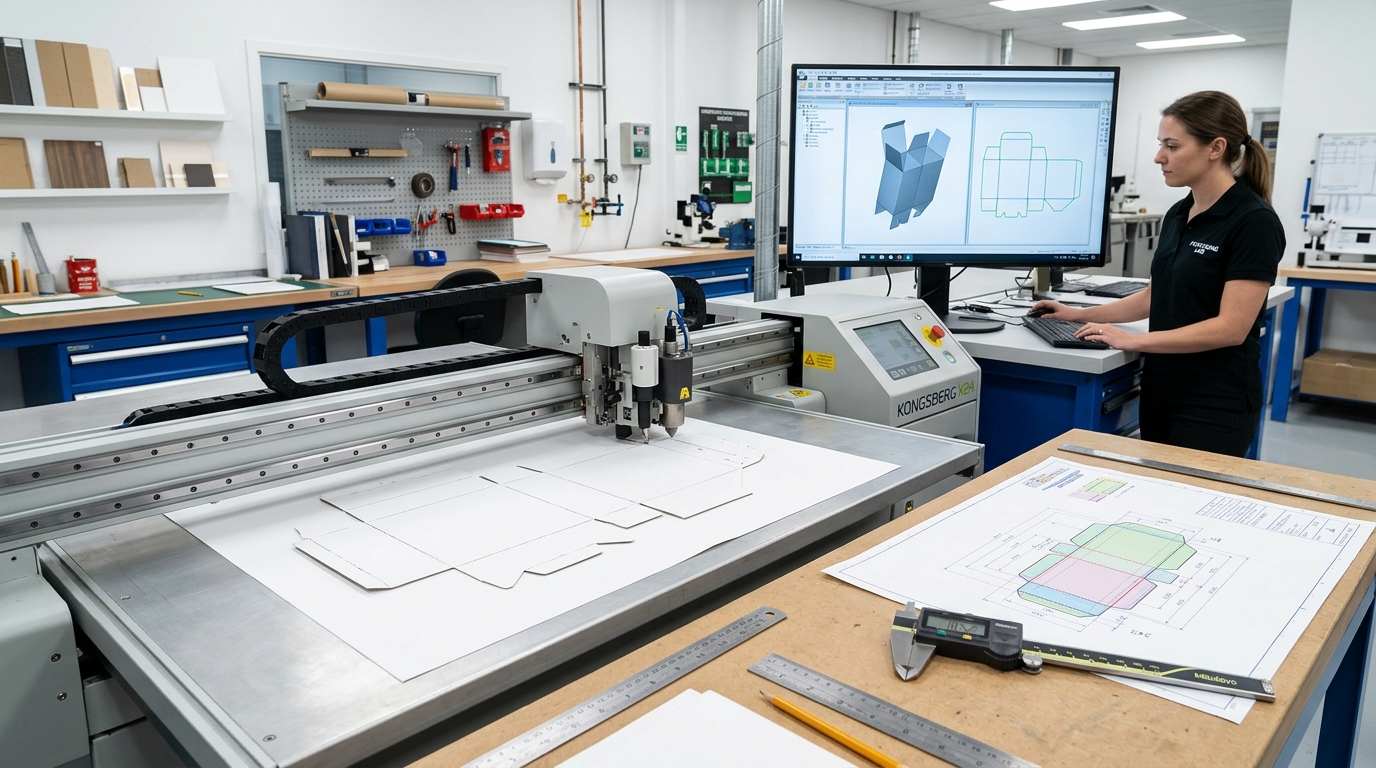
- Check their in-house tooling capability. A genuine manufacturer cuts structural white samples in-house using digital knife plotters in less than 24 hours.
2. The 6-Stage Deterministic OEM/ODM Workflow
At Naike, we have distilled our OEM/ODM custom packaging pipeline into a strict, repeatable engineering sequence that guarantees zero-defect bulk delivery:
- Stage 1: Structural Scoping & Dieline Blueprint (Hours 0-12): We do not ask you to guess box dimensions. You send us your product CAD file or physical specimen. We calculate exact tolerances (factoring in paper caliper creep) and return an ArtiosCAD/Adobe Illustrator vector dieline within 12 hours.
- Stage 2: CNC White Sample Cutting (Hours 12-48): Before anyone spends money on expensive steel cutting dies or printing plates, our digital flatbed knife cutter cuts unprinted structural samples on actual virgin kraft or greyboard stock. We drop-test the prototype with your product inside.
- Stage 3: Color Proofing & Surface Finishing Approval: Color on an illuminated computer monitor (RGB) never matches dried ink on porous paperboard (CMYK). We output calibrated GMG digital proofs or wet press proofs with your exact Pantone spot colors, hot foil stamping, and matte soft-touch laminations for physical sign-off.
- Stage 4: Automated Tooling & Mass Converting: We laser-etch steel rule dies with counter-plates for our automated Swiss Bobst flatbed die-cutters. Running speeds exceed 6,000 sheets per hour with ±0.2mm registration accuracy.
- Stage 5: 100% In-Line Inspection & Lab Batch Testing: Every production batch undergoes automated optical camera inspection for glue seam integrity, followed by destructive TAPPI T 811 (Edge Crush Test) and ASTM D642 (Box Compression Test) in our on-site laboratory.
- Stage 6: Export Moisture Wrapping & Global DDP Dispatch: Cartons are bundled, strapped with plastic corner protectors, palletized on heat-treated export pallets (ISPM 15 compliant), wrapped in 5 layers of heavy moisture-barrier stretch film, and loaded into containers.
3. Avoiding the Color Drift Nightmare: G7 Master Certification
"Why does my signature brand green look muddy brown on this batch?"
Color inconsistency across repeat orders happens when factories run presses by eye rather than by spectrophotometer data. At Naike, our printing department is G7 Master Certified. We calibrate the ink density and gray balance of our 7-color Heidelberg presses against ISO 12647-2 standards.
We guarantee a Delta-E (ΔE) color variance of less than 2.0 across entire production runs of 100,000 units. To the human eye, a Delta-E under 2.0 is virtually imperceptible. When your boxes hit retail shelves side-by-side, the brand color is 100% consistent across every single unit.
4. Sensible MOQ Strategies for Scaling Brands
Many manufacturers turn away growing brands by demanding astronomical 20,000-unit minimum order quantities (MOQs).
Because our factory operates both flexible digital converting lines and high-speed automated offset machinery, we offer a realistic tiered onboarding path:
- Pilot Validation Run (500 to 1,000 pcs): Test new product market fit without tying up working capital.
- Scale Run (3,000 to 10,000 pcs): Unlock high-speed offset pricing with unit costs dropping by up to 35%.
- Enterprise Mass Production (25,000 to 500,000+ pcs): Dedicated converting schedules with full container-load (FCL) sea freight direct to your 3PL.
5. The 5 Deadliest Pitfalls in Overseas Packaging Procurement
When you manage packaging manufacturing 6,000 miles away, small oversights become catastrophic delays. Over my 16 years running factory operations, here are the five traps that consistently trip up procurement managers:
- Relying on On-Screen PDF Visuals Instead of 1:1 Printed Mockups: Computer monitors emit light (RGB); paper reflects ambient light (CMYK). A metallic pantone color or deep charcoal gray will look luminous on a MacBook Pro screen, but dry matte and flat on uncoated kraft paperboard. Always mandate an official GMG contract digital color proof or wet press proof signed off by physical courier before approving mass printing.
- Ignoring Paper Grain Direction (Machine Direction - MD): Paper fibers align in the direction the paper machine rolls. Folding paper parallel to the grain creates a clean, sharp crease; folding perpendicular to the grain causes fiber splitting and rough edges. Your dieline supplier must orient the cutting die so that primary functional hinges run parallel to the paper grain.
- Forgetting Paper Creep in Multi-Tier Folding Cartons: When paperboard folds, the thickness of the sheet creates dimensional creep (approx. 1.5 × board caliper). If an internal partition is engineered with the exact dimensions of the outer shell without subtracting creep clearance, the insert will bow inward and distort the box.
- Skipping Glue Flap Surface Treatment on UV Coated Boxes: Water-based adhesives cannot bond to cured high-gloss UV varnish or plastic soft-touch films. If your artwork places heavy ink or UV varnish across the glue seam, the box will pop open during fulfillment. At Naike, our die-cutters use plasma corona discharge or laser ablation to strip the glue flap bare, ensuring molecular-level adhesive bonding.
- Vague Incoterms & Hidden Port Fees: Be wary of suppliers quoting unrealistically cheap "CIF" (Cost, Insurance, Freight) prices. Often, dishonest brokers use low CIF rates to win orders, but assign the shipment to predatory destination forwarders who charge exorbitant destination terminal handling charges (DTHC) upon arrival. Always request transparent FOB (Free on Board) or fully itemized DDP (Delivered Duty Paid) pricing where all customs, tariffs, and inland trucking fees are locked upfront.
6. Quality Assurance Protocol & Pre-Shipment Inspection (PSI) SOP
How does Naike ensure that carton #100,000 is just as flawless as carton #1? We enforce an ISO 2859-1 (AQL 1.0 Major / 2.5 Minor) inspection standard across all bulk orders:
- Optical Camera Seam Verification: High-speed optical cameras mounted on our automated folder-gluers inspect glue bead continuity at 400 meters per minute. Any unglued or misaligned box is pneumatically kicked into a reject bin in 0.05 seconds.
- Spectrophotometer Color Auditing: Every 2,000 sheets through our Heidelberg offset presses, our QC technicians scan color bars with X-Rite spectrophotometers. If Delta-E exceeds 1.8, the press automatically pauses for ink fountain recalibration.
- Rub Resistance & Scratch Testing: Printed sheets undergo 1,000 cycles on a Sutherland Rub Tester under a 4-lb weight to ensure ink and foil do not smudge or transfer onto adjacent products during shipping vibration.
- 100% Pre-Shipment Audit Report: Before any container is loaded at our Jinjiang campus, we provide the buyer with a 15-page photographic inspection report detailing carton dimensions, ECT burst scores, barcode scan readability, pallet stretch-wrap thickness, and container seal numbers.
7. Transparent Payment & Escrow Structures for First-Time Buyers
We know that wire-transferring funds overseas to a new manufacturing partner can feel daunting. That is why Naike offers predictable, milestone-based commercial terms designed to protect both parties:
- $49.90 Physical Prototype Phase: Zero commitment. Test our engineering precision on your own desk with real physical samples before signing any mass production contract.
- Standard 30/70 Commercial Milestones: 30% deposit upon digital CAD/artwork sign-off; remaining 70% balance payable only after receiving your comprehensive Pre-Shipment Inspection Report and third-party lab certificates.
- Established Credit Terms: For recurring enterprise clients with audited financial credentials, we support Net 30 or Net 60 open account terms backed by Sinosure (China Export & Credit Insurance Corporation).
8. Heidelberg Press Calibration & In-Line Spectrophotometry
Let's talk about the beating heart of high-end packaging manufacturing: the printing pressroom.
At our Jinjiang production center, our primary converting lines are powered by German Heidelberg Speedmaster CD102 presses equipped with 7 color printing units, anilox coater towers, and extended infrared/UV curing deliveries.
How do our press operators ensure that your brand color remains identical across 100,000 boxes running at 15,000 sheets per hour?
- Prinect Image Control Color Spectrophotometry: As printed sheets exit the delivery stacker, an optical spectrophotometer scans a dedicated 4mm color calibration bar printed along the gripper margin. It measures 160 color patches in less than 20 seconds, analyzing optical ink densities, dot gain (TVI), and CIELAB color values across all 7 printing units simultaneously.
- Automated Motorized Ink Fountain Adjustment: If the Cyan or Magenta density drifts by more than 0.05 from the digital master target, the Heidelberg console automatically commands micro-motors in the ink fountain keys to open or close by fractions of a millimeter in real time, locking Delta-E below 1.8 across entire 48-hour continuous press runs.
- Humidity-Controlled Paper Feeding: Paper absorbs ink differently depending on ambient moisture. Our pressroom air conditioning maintains strict 55% ±5% RH and 23°C temperature equilibrium 24 hours a day, preventing paper expansion or static cling during high-speed feeder suction.
9. Tooling Engineering: Bobst Steel Rule Dies vs. Rotary Cutters
The precision of your box's interlocking tabs and dust flaps is governed entirely by the die-cutting board. Cheap suppliers use manual wooden puzzle boards hand-bent with pliers.
At Naike, our die tooling follows aerospace-level engineering standards:
- Laser-Cut Multiplex Birch Plywood Bases: High-power CO2 laser cutters slice 0.71mm slots into 18mm high-density Finnish birch plywood with ±0.02mm beam precision, ensuring knife slots never loosen over 500,000 impressions.
- Hardened Austrian Bohler Steel Rule Knives: Cut and crease blades are formed with CNC automatic benders, ensuring exact 90-degree corner radiuses and zero tooth gap at join points.
- Micro-Cellular Ejection Rubbers: Specially calibrated rubber blocks with tailored Shore A hardness ratings (from 35° soft sponge up to 70° solid vulcanized rubber) are bonded along the blades to gently eject the paper sheet without surface bruising or indentation marks.
10. Comprehensive OEM/ODM Buyer's Onboarding Roadmap
Here is how we guide new international clients from their initial sketch to their first full-container delivery in six clear steps:
- Day 1: Technical Scoping: Send product specimens or 3D STEP/IGES files. We return a custom 2D Adobe Illustrator/ArtiosCAD dieline within 12 hours.
- Day 3: Rapid Physical Prototype ($49.90): CNC knife plotters cut unprinted structural white samples on real stock, shipped via DHL Express for fitment verification.
- Day 7: Artwork & Color Proof Sign-Off: You upload vector artwork. We provide 3D digital unboxing video previews and physical calibrated GMG digital color proofs.
- Day 10: Tooling & Mass Production Kickoff: Laser steel rule dies are etched and mounted onto automated Bobst cutting presses. Heidelberg presses begin conversion.
- Day 18: Quality Assurance & PSI Report: Destructive laboratory batch testing (ECT, BCT, drop tests) is conducted. We deliver a comprehensive 15-page photographic inspection dossier.
- Day 20: Palletized Container Dispatch: Full container loads are shrink-wrapped and loaded for direct ocean or air freight dispatch with full bill of lading tracking.
Ready to Kick Off Your Packaging Project with Naike?
Send us your product dimensions or CAD drawing. We will provide a free 12-hour vector dieline blueprint, 3D unboxing proof, and direct factory tier quotation.